1. Paying attention
Earlier this year, I took up the noble hobby of birdwatching. Until I started actively listening for birds, I hadn’t registered at all the plentiful songbirds near my house. Once I began focusing on the sounds around me, even when I wasn’t looking for something in particular, I started to notice birds everywhere.
My friends can do this too. If we go on a walk and I hear an interesting bird nearby, I will sometimes ask them to listen, and they will immediately hear the same bird without me describing the particular sound. You can try this right now: just listen ambiently, wherever you are, and recognise the sounds you’ve tuned out.
It doesn’t take long for this effort to pay off. Now, listening for birds has become a background process in my mind. I will usually hear them even when I’m thinking about other things. In the first level of noticing, it is sufficient to pay attention in general.
2. Being guided
In the second level, attention is not enough: you need guidance.
I recently saw Matisse’s Woman with a Hat in person. It was my first encounter with the painting and, being unfamiliar with art and art history, I was trying to figure out why it was interesting enough to warrant a feature at the museum.
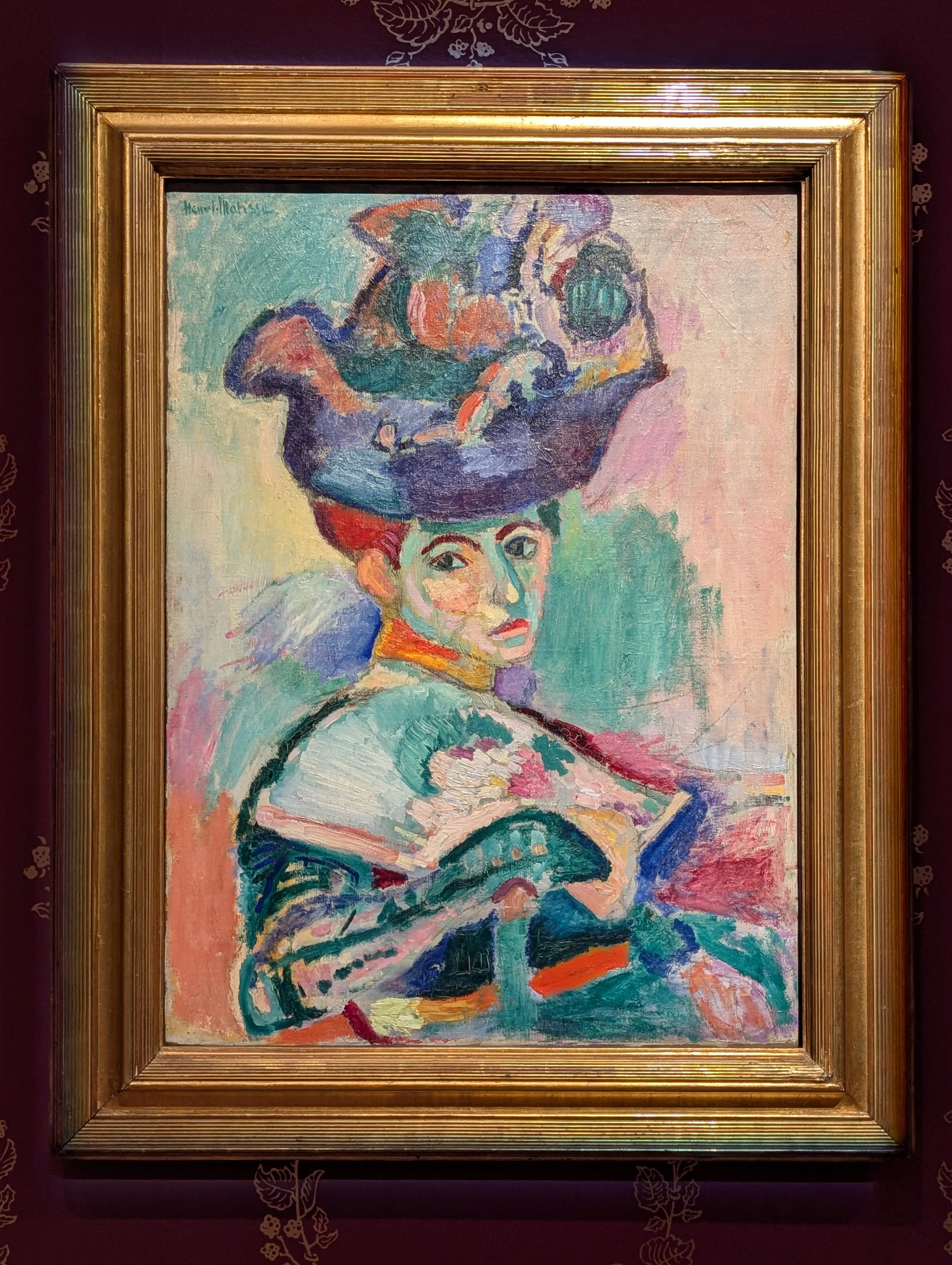
I asked an LLM to explain why the painting was significant. I was informed that when it was first exhibited, the painting drew criticism because of Matisse’s haphazard style and unrealistic colour palette, particularly the green and pink on the woman’s face.
I hadn’t even realised the face had green paint! It had to be pointed out to me for me to notice it.
In this next video, two jazz musicians are appreciating a Steely Dan track. See if you can catch the nuance they’re listening to before it’s explained.
The drum fill was there the first time the track was played (Adam Maness (on the left) even mimes it). But until he highlighted it on the second pass, I didn’t notice it. This is different from inattention. I am focused on the music, I am looking for the interesting part, but I just cannot comprehend the particular thing until it is pointed out to me, and then finally I hear itWithout guidance, it just feels like they’re oohing and mmhing at random times. What are they hearing? I listen but I cannot understand.. It is the same with the painting.
Here’s another example. In the clip, Tom Wessels explains how to interpret a pit next to a mound on the forest floor — a tree fell over a long time ago, its roots tore up the dirt with it to create a hollow, and the mound is created from the soil lifted by the roots.
I must have seen features like these dozens of times without recognising they meant something. To notice more, I can ask LLMs what I should look at. But I find them much less useful for musicBecause they haven’t actually heard the music. They have seen the paintings, though., and it is not always obvious when to invoke them. Much more effective to walk in the forest with Tom Wessels. So my prescription in this second level, particularly in aesthetics and the natural world, is to find an expert.
3. Changing yourself
In the third level of noticing, guidance is insufficient. There are some things I cannot perceive even when I am explicitly told what to observe. Consider, for instance, Noah Kellman reproducing a really fast melody.
I can’t even hear most of the notes! If you asked me to sing the melody I’d go vaguely higher and lower at the right times, but not hit the right pitches. And I wouldn’t be able to correct myself no matter how many times I listen, because I literally can’t perceive what I’m aiming for. So despite the specific thing has been pointed out to me, I cannot observe it.
Architecture, dancing, chess, wine… I imagine in all of these areas, my appreciation and understanding are lessened. I suspect that I must become an expert myself: read the history, spend time with experts, spend more time with the material, memorise, alter my perception, change myself.
One comfort is that it doesn’t seem to take that much effort to be able to begin discerning. I started picking up song structure, the different instruments, and swing feel after only a dozen hours of an online jazz appreciation course. I still can’t hear what the musicians in the videos above automatically can, though. To notice deeply and immediately, you just have to spend the time.
Further reading
Sasha Chapin writes about how to appreciate everything more. Many of his suggestions change the cognitive frame with which you approach something. For example, one way of looking at art is to pretend you are a buyer. How would you decide how much it’s worth? Another perceptual shift is to notice your body’s reactions rather than your mind’s. His suggestions are ways of guiding attention along unusual pathways.
Scott Alexander writes about human experiences you may be missing without realising it. In the most striking example, a person who couldn’t smell didn’t realise it for years, until a chance homework assignment got her to really think about the smell of a peach. This is a problem beyond this post. How do you even know what to pay attention to?